A company registration number in Germany is a unique identifier assigned to a business upon its entry into the German trade register (Handelsregister). If you are forming or acquiring a German company, you will receive an HRB number (for capital companies such as GmbH or AG) or an HRA number (for partnerships and sole traders). This number confirms your company’s legal existence and appears on all official correspondence, invoices, and contracts.

However, the Handelsregisternummer is only one of several identification numbers a German business receives. In our 19 years of forming German companies, we have seen many founders confuse these numbers or underestimate how long the process takes. Here is a breakdown of the key identifiers:

  • Handelsregisternummer (HRB/HRA) — assigned by the local district court (Amtsgericht) when your company is entered into the trade register. This is what most people mean by “company registration number.”
  • Steuernummer — your tax number, issued by the local tax office (Finanzamt) for income and corporate tax purposes. It follows a regional format and changes if your company relocates to a different tax district.
  • USt-IdNr (Umsatzsteuer-Identifikationsnummer) — your VAT identification number, issued by the Federal Central Tax Office (Bundeszentralamt für Steuern). Required for intra-EU trade and formatted as DE followed by nine digits.
  • Betriebsnummer — an eight-digit employer number issued by the Federal Employment Agency (Bundesagentur für Arbeit). Required as soon as you hire your first employee.

Each number serves a distinct purpose in German administrative and tax law. You will need most or all of them within the first weeks of operating your business.

Any person or entity with a legitimate interest may request a German company’s registration number. Under § 9 of the German Commercial Code (HGB), the trade register is a public record. This means you do not need to be a shareholder, creditor, or business partner to look up a company’s HRB or HRA number.

You can search the register directly at handelsregister.de, the official portal operated by the German federal states. Basic searches by company name or registered office are free of charge. Retrieving full register extracts or historical filings may incur a small fee (typically between EUR 1.50 and EUR 4.50 per document).

Business partners, banks, investors, and regulatory authorities routinely verify company registration numbers before entering into contracts or extending credit. If you are establishing a GmbH in Germany, your registration number will be one of the first pieces of information that clients and suppliers request.

How to get an Identifikationsnummer in Germany and why you need it

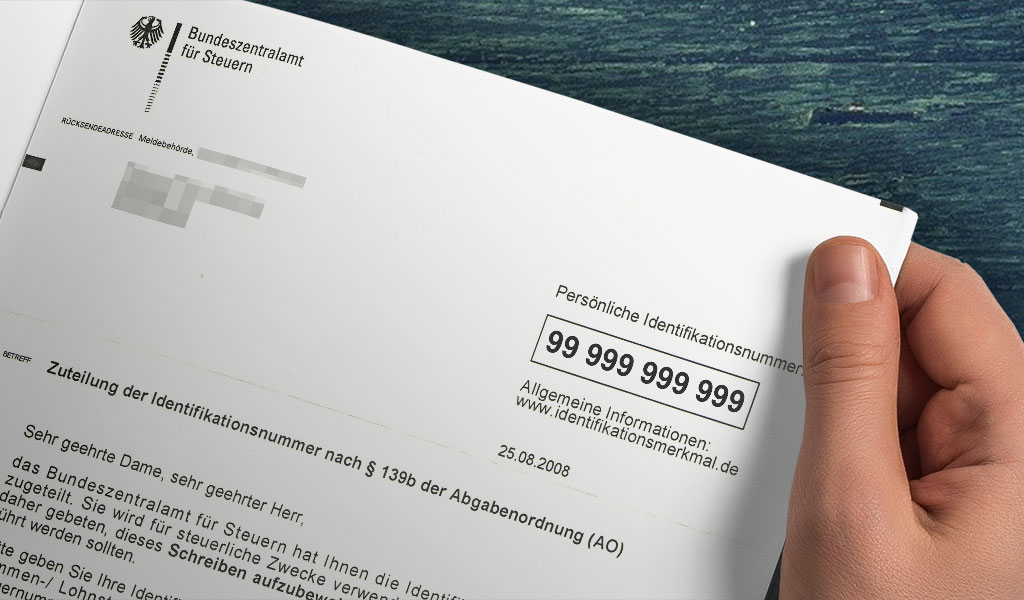
The Steuer-Identifikationsnummer (Steuer-ID or IdNr) is an 11-digit personal tax identification number introduced in Germany in 2008 under § 139b of the German Fiscal Code (Abgabenordnung, AO). It is assigned to every individual registered with a German residence — including foreign nationals who move to Germany or register a sole proprietorship.

Unlike the Steuernummer, which can change when you move between tax districts, the Steuer-ID remains the same for your entire lifetime. It was created to simplify communication between taxpayers and the tax authorities and to reduce administrative errors caused by duplicate records.

Who receives a Steuer-ID:

  • Every person who registers a residence in Germany (Anmeldung) receives one automatically. The Federal Central Tax Office (Bundeszentralamt für Steuern, BZSt) sends it by post to your registered address, usually within two to four weeks of registration.
  • Newborns registered in Germany receive their Steuer-ID shortly after birth.
  • Foreign nationals who register at the local residents’ office (Einwohnermeldeamt) also receive one automatically.

How to obtain or retrieve your Steuer-ID:

  1. Check your initial letter — When you first registered your German address, the BZSt sent a letter containing your Steuer-ID. This is the fastest way to find it.
  2. Look at previous tax assessments — Your Steuer-ID appears on every income tax assessment notice (Einkommensteuerbescheid) and annual wage tax certificate (Lohnsteuerbescheinigung).
  3. Request it from the BZSt — If you have lost the letter, you can request your Steuer-ID online at bzst.de. For security reasons, the number is sent by post only — not by email or telephone. Expect a waiting period of approximately four to six weeks.
  4. Ask your employer — Your employer has your Steuer-ID on file for payroll purposes and can provide it to you.

The Steuer-ID is strictly a personal number. It does not apply to companies. A GmbH, UG, or AG receives a separate Steuernummer (corporate tax number) and, if applicable, a USt-IdNr for VAT. If you are setting up a business, you will need both your personal Steuer-ID and your company’s Steuernummer — they are not interchangeable.

The Steuer-Identifikationsnummer serves as your permanent link to the German tax system. The Federal Central Tax Office uses it to track your tax records across all federal states, regardless of how often you move or change your local Finanzamt.

For individuals, the Steuer-ID is required in the following contexts:

  • Employment — Your employer needs your Steuer-ID to process payroll and submit electronic wage tax data (ELStAM) to the tax authorities.
  • Banking — German banks request your Steuer-ID when you open an account, in order to report interest income and comply with the automatic exchange of financial information under the EU’s Common Reporting Standard (CRS).
  • Tax returns — Every annual income tax return (Einkommensteuererklärung) must include your Steuer-ID.
  • Government benefits — Applications for child benefit (Kindergeld), housing benefit (Wohngeld), and other social transfers require your Steuer-ID.
  • Freelance registration — If you start a business in Germany as a Freiberufler or sole trader, the Finanzamt uses your Steuer-ID alongside your Steuernummer to manage your tax file.

Without a Steuer-ID, you cannot take up employment, file taxes, or receive most government services in Germany. It is, in effect, mandatory for anyone who lives or works in the country.

You will be asked to provide your Steuer-Identifikationsnummer in a wide range of situations. The most common include:

  • Starting a new job — your employer cannot process your first payslip without it.
  • Opening a bank account — required by all German banks and financial institutions under § 154 AO.
  • Filing your annual tax return — both paper and electronic (ELSTER) submissions require the number.
  • Applying for Kindergeld (child benefit) — both the parent’s and the child’s Steuer-IDs are required.
  • Registering a freelance or trade activity with the Finanzamt.
  • Receiving capital gains or interest — your bank uses the Steuer-ID to issue exemption orders (Freistellungsauftrag) and report withholding tax.
  • Applying for certain public subsidies and social benefits.

Keep your Steuer-ID in a safe place. You will need it repeatedly throughout your professional and financial life in Germany.

What is Identifikationsnummer for

Would you talk with someone in our company regarding any issues? Just drop us a line!

The Handelsregisternummer is the core registration number for any German company entered in the trade register. It is assigned by the registrar at the local district court (Amtsgericht) responsible for the company’s registered office. The number consists of a prefix — either HRB or HRA — followed by a numeric sequence.

HRB vs HRA — the difference:

PrefixRegister sectionCompany types
HRBAbteilung B (Handelsregister B)GmbH, UG (haftungsbeschränkt), AG, KGaA, SE
HRAAbteilung A (Handelsregister A)OHG, KG, GmbH & Co. KG, sole traders (eingetragene Kaufleute, e.K.)

A GmbH registered at the Amtsgericht München might, for example, carry the number HRB 123456, Amtsgericht München. This combination of prefix, number, and court uniquely identifies the company across Germany. Under § 37a HGB, every registered business must display its Handelsregisternummer on all business letters, including emails, together with the legal form, registered office, and court of registration.

Where to find a company’s Handelsregisternummer:

  • handelsregister.de — the official search portal of the German trade register. You can search by company name, registered office, or registration number. Basic index searches are free; downloading official documents costs between EUR 1.50 and EUR 4.50.
  • Company website or imprint — German law requires every commercial website to include an Impressum listing the Handelsregisternummer (§ 5 DDG).
  • Invoices and correspondence — the number must appear on all business letters, as noted above.

Steuernummer vs USt-IdNr — understanding the difference:

The Steuernummer (tax number) is issued by your local Finanzamt and used for corporate income tax, trade tax, and income tax filings. Its format varies by federal state. If your company moves to a different tax district, you receive a new Steuernummer.

The USt-IdNr (VAT ID) is issued by the Federal Central Tax Office and follows a standardised format: DE + nine digits. You need it for cross-border EU transactions. For detailed guidance, see our article on VAT registration in Germany.

How to look up any German company’s registration number:

  1. Go to handelsregister.de and select “Normal search.”
  2. Enter the company name and the federal state or city where the company is registered.
  3. The results will show the HRA/HRB number, the responsible Amtsgericht, and the company’s current status.
  4. Click on the entry to view available documents, including the current register extract and historical filings.

If you are forming a company, the Handelsregisternummer is only assigned after the notarised articles of association have been filed and the court has processed the application. For a GmbH or UG, this typically takes one to four weeks.

Faq

A company registration number in Germany — known as the Handelsregisternummer — is the unique identifier assigned when a business is entered into the German trade register (Handelsregister). It consists of a prefix (HRB for capital companies, HRA for partnerships) and a number, issued by the local district court (Amtsgericht). Every GmbH, AG, UG, OHG, and KG receives one upon registration. It must appear on all business letters, invoices, and the company website’s Impressum, as required by § 37a HGB.

The fastest method is to search the official trade register portal at handelsregister.de. Enter the company name and location, and the results will display the HRA/HRB number and the responsible court. You can also find the number in the company’s Impressum (legal notice on their website), on their invoices, or by requesting a register extract from the relevant Amtsgericht.

HRB (Handelsregister Abteilung B) is used for capital companies — GmbH, UG (haftungsbeschränkt), AG, and SE. HRA (Handelsregister Abteilung A) is used for partnerships (OHG, KG, GmbH & Co. KG) and registered sole traders (e.K.). The distinction reflects the separate sections of the trade register, each governed by different disclosure and reporting requirements.

The Steuernummer is a tax number issued by your local Finanzamt for income and corporate tax purposes. Its format varies by federal state and changes if your company moves to a different tax district. The USt-IdNr (VAT identification number) is issued by the Federal Central Tax Office (BZSt) and follows a uniform format (DE + nine digits). You need the USt-IdNr for intra-EU transactions and to verify the VAT status of EU business partners via the VIES database.

No. Only companies and sole traders that are entered in the trade register receive a Handelsregisternummer. Freiberufler (freelance professionals such as doctors, lawyers, architects) and small trade businesses (Kleingewerbetreibende) that are not required to register under the HGB do not receive one. They operate with a Steuernummer and, if applicable, a Gewerbeschein (trade licence) instead.

Visit handelsregister.de and use the “Normal search” function. You can search by company name, keywords, registered office, or registration number. Basic index results are free. To download official documents — such as the current register extract, articles of association, or annual financial statements — you will pay a small fee, typically EUR 1.50 to EUR 4.50 per document.

The Betriebsnummer is an eight-digit employer identification number issued by the Federal Employment Agency (Bundesagentur für Arbeit). You must apply for one as soon as you hire your first employee who is subject to social insurance contributions. It is used for all communications with health insurance funds and social security bodies. The number is usually assigned within a few working days.

After notarisation of the articles of association and filing with the trade register, a GmbH registration typically takes one to four weeks, depending on the workload of the local Amtsgericht. Some courts in major cities (Berlin, Munich, Hamburg) may take longer due to higher volumes. Once the entry is made, you receive the HRB number by post.

Yes. The official portal handelsregister.de allows you to verify any company’s registration number, current status, legal form, registered office, and managing directors. For VAT numbers, the European Commission’s VIES system lets you check whether a USt-IdNr is valid and associated with an active business. Both services are accessible free of charge for basic verification queries.

After registering a GmbH, you will receive or need to apply for: Handelsregisternummer (HRB) — assigned by the Amtsgericht; Steuernummer — issued by the local Finanzamt within two to four weeks; USt-IdNr — issued by the BZSt if you conduct intra-EU transactions; Betriebsnummer — required only if you employ staff; and an EORI number — required if you import or export goods outside the EU. For a full walkthrough, see our guide on starting a business in Germany.

Would you talk with someone in our company regarding any issues? Just drop us a line!

Last news